

The Quietest Battle in the UK Automotive Market
There is a battle brewing in the UK. It’s a battle being fought out in the quietest of ways, and a battle that the world’s biggest OEM absolutely HAS to win. The question is though, will they?
For decades, the pickup market has been gloriously predictable.
If you wanted reliability, you bought a Toyota Hilux. If you wanted something tough and honest, perhaps an Isuzu D-Max or a KGM (formerly Ssang Yong) Musso. The sector has traditionally been dominated by diesel engines, ladder-frame chassis and buyers who care far more about payload, towing and durability than they do about touchscreen graphics and smartphone apps.
But something remarkable has happened.
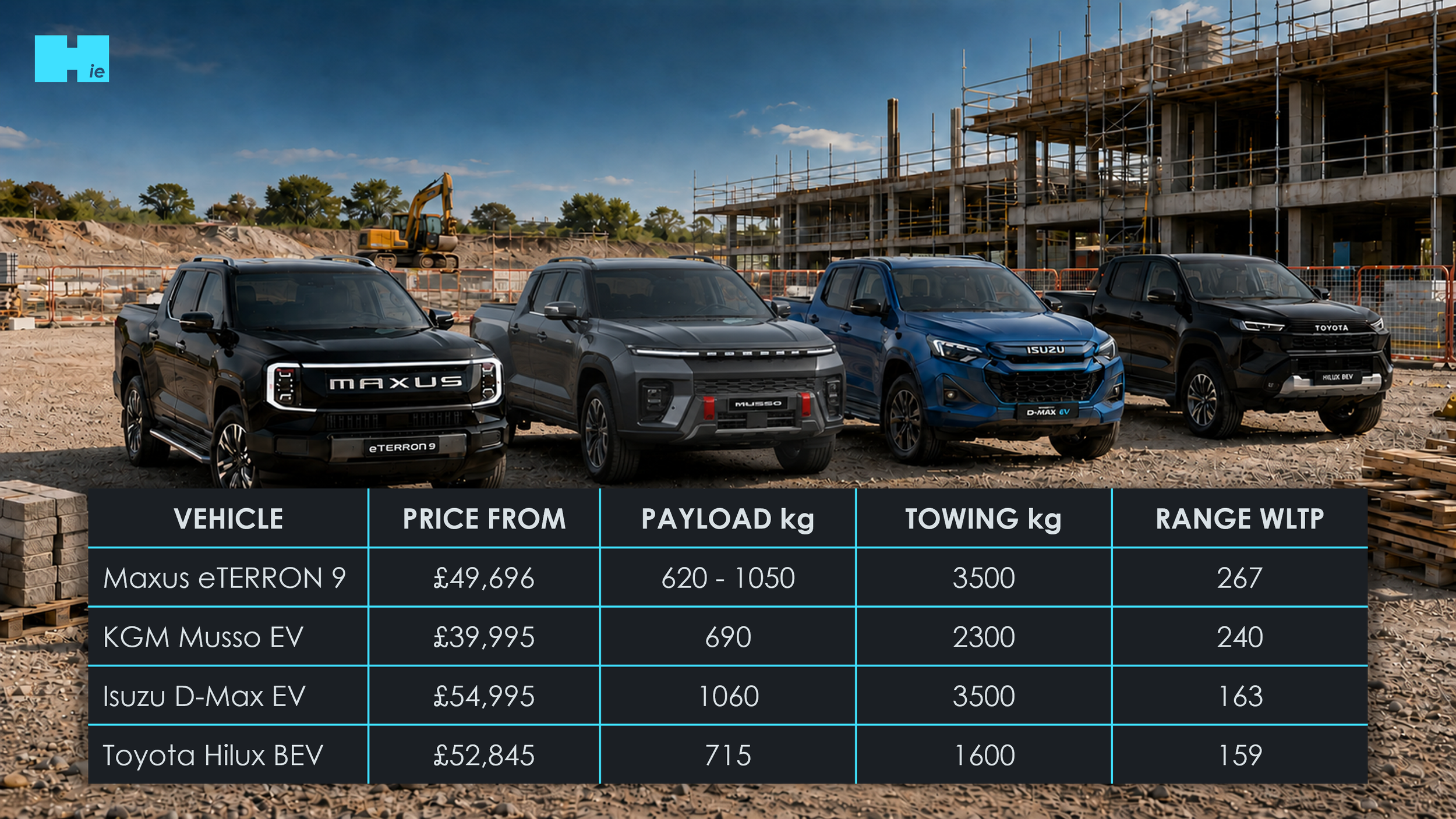
For the first time ever, UK buyers can now choose from four fully electric pickup trucks. That's not a concept. Not a prototype. Not a promise. Four vehicles either on sale or arriving in customer hands now, competing for what could become one of the most strategically important segments in the commercial vehicle market.
And the fascinating part?
Three of those four trucks come from manufacturers that, historically, few pickup buyers would have considered.
Meet the New Challengers
Today's UK EV pickup market consists of:
Maxus eTERRON 9
KGM Musso EV
Isuzu D-Max EV
Toyota Hilux BEV
At first glance, it looks like Toyota and Isuzu should comfortably dominate.
After all, these brands have spent decades building reputations for producing vehicles capable of surviving construction sites, farms, mines, floods and just about every other abuse their owners can throw at them.
Yet the numbers suggest this battle may not be quite so straightforward.
The Maxus Problem
If there is one vehicle causing established manufacturers sleepless nights, it might be the Maxus eTERRON 9. Priced from around £49,696, it delivers a claimed 267-mile WLTP range, comfortably the longest of the current contenders. Publicly available reviews also highlight its 3.5-tonne towing capability and surprisingly premium cabin experience, positioning it as the most complete electric pickup currently available. The challenge for competitors is obvious. Electric pickups already face scepticism from traditional buyers. Range anxiety, charging concerns and higher purchase prices are common objections. So when one manufacturer appears with the strongest range, full towing capability and a modern SUV-like interior, it instantly becomes the benchmark everyone else must beat.
The surprise isn't that Maxus built a good truck.
The surprise is that everyone else allowed them to get there first.
KGM's Different Approach
While Maxus has focused on capability and technology, KGM has taken a different route. The Musso EV's headline figure isn't its range or performance. It's the price. At £39,995, it significantly undercuts its rivals, creating a compelling proposition for fleets trying to electrify without absorbing premium vehicle costs. More importantly, it feels like a commercial decision rather than an engineering exercise. For many businesses, a vehicle doesn't need to be the best. It simply needs to do the job at the lowest total cost of ownership. If KGM can convince buyers that its electric pickup is strong enough, whilst saving thousands at point of purchase, it may prove a bigger threat than many expect. Public specifications also indicate respectable payload capabilities and 4WD functionality, reinforcing its fleet appeal.
Isuzu Stays True to Its Roots
Nobody understands work trucks quite like Isuzu. The D-Max has built an incredibly loyal following by doing exactly what pickup buyers ask of it: turning up every day and getting on with the job. The electric version appears to follow that same philosophy. Rather than reinventing the formula, Isuzu seems determined to preserve the characteristics that made the diesel D-Max successful in the first place. With a payload exceeding one tonne and a full 3.5-tonne towing capacity, the D-Max EV arguably remains closest to the traditional expectations of commercial pickup buyers. The challenge is energy. The D-Max EV's range figure sits significantly below some rivals, meaning buyers must decide what matters most. Maximum productivity? Or maximum electrification? For many fleets, that decision won't be as obvious as EV enthusiasts might assume.
Toyota's Most Important Test Yet
And then there is Toyota. A brand renowned for hybrid leadership, manufacturing excellence and arguably the most famous pickup nameplate on the planet. The Hilux is more than a vehicle. It's an institution. That's precisely why this moment feels so significant. Because Toyota isn't entering a market it created. It's entering a market where others have already established momentum. The Hilux BEV arrives carrying immense expectations. Buyers expect it to be reliable. They expect it to be durable. They expect it to live up to decades of reputation. What they won't automatically do is buy it simply because it says "Hilux" on the grille. In the EV era, historical brand equity still matters. But specifications matter too. Range matters. Charging matters. Payload matters. Running costs matter. And right now, Toyota faces the unusual challenge of needing to prove that the benchmark pickup can also become the benchmark electric pickup.
The Bigger Question
The real story isn't which of these four vehicles sells the most units this year. It's what their arrival tells us about where the market is heading. For years, electric commercial vehicles have focused primarily on vans. That made sense. Urban routes are predictable. Vehicles return to base each night. Charging is relatively straightforward. Pickups are different.
They work in remote locations.
They tow.
They carry heavy loads.
They spend long days away from depot infrastructure.
If electric pickups can succeed here, then genuine electrification of the wider commercial vehicle sector becomes far more realistic. That's why this matters. The battle between Maxus, KGM, Isuzu and Toyota is about far more than pickup trucks. It's a test of whether electrification can finally move beyond the predictable fleet sectors and establish itself in some of the most demanding applications on the road. And perhaps that's why the world's biggest OEM absolutely has to win. Because if Toyota can't convince traditional pickup buyers that electric works, who can?
The quietest battle in the automotive industry has begun.
And unlike the diesel wars that came before it, you probably won't hear it coming.